Innovation Economies & The Business of Emerging Tech

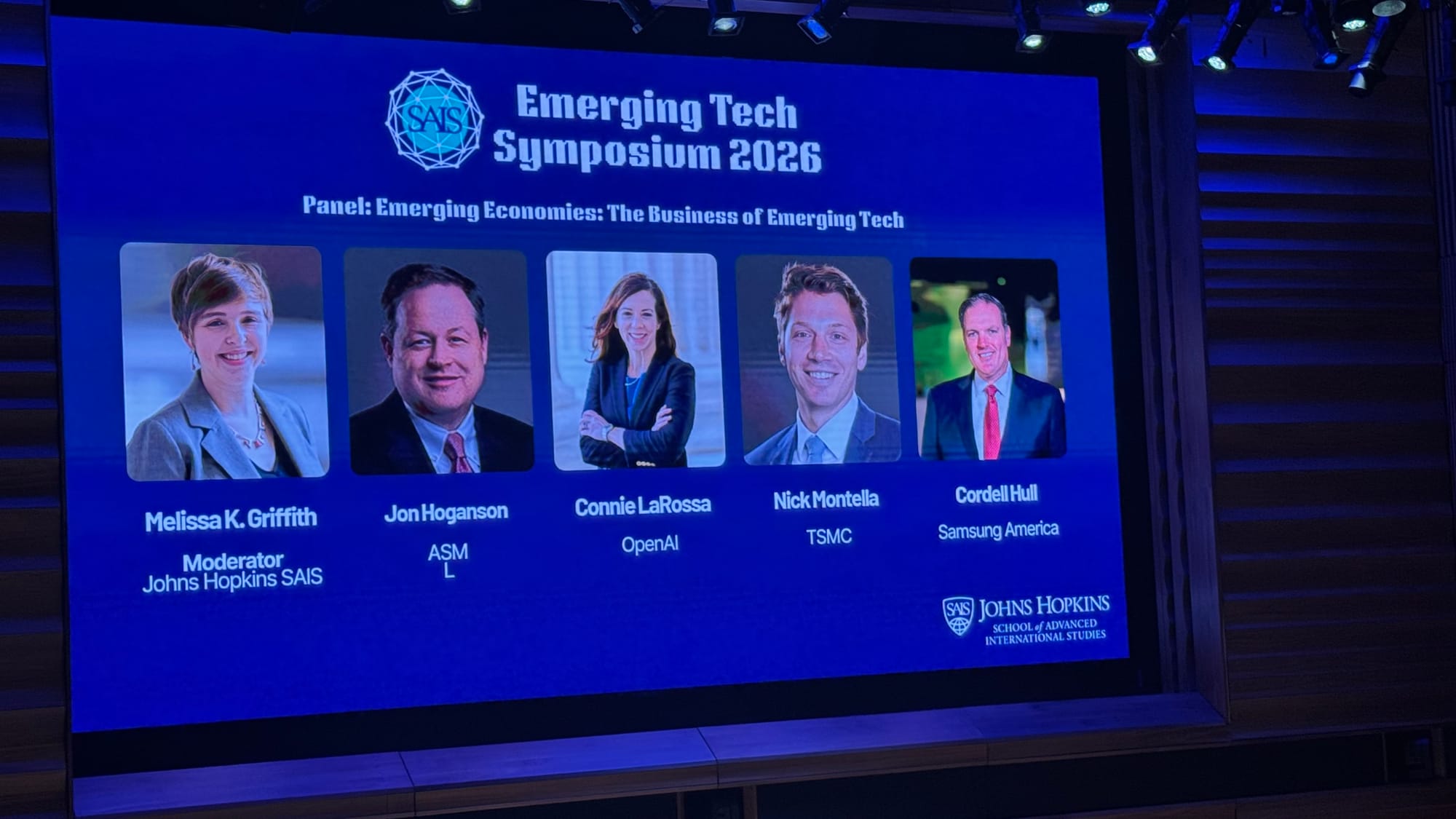
At the 2026 Emerging Tech Symposium at Johns Hopkins SAIS, the panel on “Innovation Economies & The Business of Emerging Tech” focused less on any single technology and more on the commercial architecture that makes emerging technology possible in the first place. Moderated by Melissa K. Griffith, the discussion featured Connie LaRossa, Head of National Security Policy and Community at OpenAI; Jon Hoganson, Head of U.S. Government Affairs at ASML; Nick Montella, Director of Global Government Affairs at TSMC; and Cordell Hull, Executive Vice President and Head of U.S. Public Affairs at Samsung Electronics America.
Rather than reducing emerging technology to headlines, hype cycles, or a narrow set of dominant firms, the discussion examined how these industries actually operate in practice through specialization, collaboration, demand, long innovation timelines, and a constant balance between competition and interdependence.
Public narratives often suggest that emerging technology is driven by a handful of companies building in isolation. The reality presented here was far more complex. These sectors function as deeply interconnected systems. A company designing a chip depends on the manufacturer that fabricates it, the equipment firm that enables production, the compute and cloud environment that supports deployment, the energy systems that power operations, and the downstream customers who convert technical capability into real adoption. Even in competitive environments, companies remain structurally tied to one another through a shared industrial ecosystem.
Seen through that lens, the business of emerging technology is not only about invention. It is about coordination across layers of value creation. Semiconductor manufacturing, lithography, AI models, memory, devices, packaging, cloud capacity, data infrastructure, and customer applications are all linked. Some firms operate in one layer, others span several, but none operate independently. This was not presented as an abstract idea. It was treated as the core condition under which innovation now scales.
The discussion also clarified how different companies position themselves within that system. TSMC described its role as a manufacturer of advanced semiconductors, focused on logic chips that act as the computational core of modern systems. ASML outlined its position as the producer of photolithography equipment, the machines that make advanced chip manufacturing possible. Samsung provided a broader industrial perspective, spanning semiconductors, memory, foundry services, consumer electronics, batteries, and energy systems. OpenAI represented a different layer entirely, focused on AI models and software, yet dependent on the full stack of chips, compute, data, and infrastructure required to bring those systems into operation.
What becomes clear from this structure is that emerging technology economies are neither simple nor linear. They are specialized, capital intensive, globally distributed, and increasingly shaped by infrastructure decisions as much as by scientific or technical breakthroughs.
A second insight ran through the discussion. Innovation appears fast, but the systems that support it move on much longer timelines. New models, devices, or chip generations may seem to arrive suddenly, yet the underlying research, design, manufacturing, and testing cycles often unfold over years. In semiconductors, these cycles can extend across multiple years from concept to deployment. In advanced manufacturing equipment, development timelines stretch even further. Even in AI, where progress feels immediate, the pace is still constrained by infrastructure, compute capacity, and hardware development cycles that operate over longer horizons.
This creates a visible tension. On one side, AI is advancing at a pace that feels continuous, with constant iteration and strong demand for new capabilities. On the other, the systems that enable it, including manufacturing, supply chains, and infrastructure, move more slowly and require sustained investment. That gap between perceived speed and actual timelines is shaping the current phase of the industry and placing pressure across the ecosystem.
Demand plays a central role in this dynamic. Innovation is not simply pushed forward by research. It is pulled by customers. In semiconductors, demand for performance and efficiency drives progress across design, fabrication, and equipment. In AI, enterprise adoption and user expectations place immediate pressure on compute and infrastructure. In consumer technologies, user behavior feeds directly back into product development cycles. Customer demand acts as a continuous force that links each layer of the system.
Geography introduces another layer of complexity. Decisions about where to build, invest, and expand are shaped by far more than market size. Infrastructure quality, workforce capability, regulatory conditions, long term demand, and ecosystem readiness all factor into these choices. For manufacturing focused companies, these decisions involve large scale capital commitments and multi year planning. For software and AI companies, the considerations differ in form but not in importance, as infrastructure, partnerships, and deployment environments still determine where and how services can scale.
Public policy and business reality converge on this point. Governments are actively seeking to build domestic capacity, strengthen supply chains, and secure a role in emerging technology ecosystems. However, ambition alone does not create viable systems. The discussion made clear that successful ecosystems require a combination of talent, research institutions, suppliers, infrastructure, and stable operating conditions over time. These are not outcomes that can be created quickly. They depend on sustained alignment between public and private actors.
The question of concentration was addressed with nuance. At first glance, these industries can appear highly centralized, with a small number of firms dominating key segments. That view is partially true, but incomplete. What appears as concentration often reflects deep specialization at the technological frontier. Behind these leading firms sits a broad network of suppliers, partners, research institutions, and customers. The visible layer is narrow, but the underlying system is extensive.
This is particularly evident in semiconductors, where thousands of suppliers and hundreds of customers contribute to what may appear to be a limited set of leading manufacturers. A similar pattern is visible in AI, where a small number of frontier developers attract attention, while a wider ecosystem of models, infrastructure providers, and applications continues to expand around them. The trajectory is not purely toward consolidation or fragmentation, but toward a system where specialization and interdependence coexist.
Geopolitical dynamics add another dimension. Companies operating in these sectors are no longer viewed solely as commercial actors. They are increasingly seen as strategic assets within national and international frameworks. As a result, they operate in an environment shaped by export controls, industrial policy, national security considerations, and regulatory expectations. These pressures are most visible in semiconductors and AI, but extend across the broader emerging technology landscape.
What ultimately emerged from the discussion was not a story of isolated breakthroughs or individual leaders. It was a picture of an industrial system defined by interdependence. Innovation depends not only on invention, but on the ability to build, scale, supply, and integrate across multiple layers of a shared ecosystem. The companies that succeed will not be those operating alone, but those that can navigate and contribute to this system effectively.
Recognizing that shift is essential to understanding where emerging technology is heading next.
More analysis on science diplomacy and strategic infrastructure is available at glsd.ai, where ongoing work connects policy, innovation, and international partnerships through a global lens.
New Resource: The Science Diplomacy Playbook
For readers working across diplomacy, technology policy, research strategy, investment, or international partnerships, The Science Diplomacy Playbook: 2026 Edition is now available to order.
The guide expands on many of the themes covered in Global Signals, including AI governance, critical minerals diplomacy, bilateral science and technology agreements, minilateral coalitions, research security, and the growing role of science diplomacy in industrial strategy.
It is written as a practical field guide for decision makers navigating the intersection of science, technology, and global affairs.
Available as a paperback and kindle on Amazon, with ebook editions on Apple Books, Fable, and Everand. Library distribution rolling out across North America, the United Kingdom, and Europe through Tolino, Vivlio, Smashwords, Gardners, BorrowBox, and cloudLibrary.
Join Global Signals
A biweekly strategic brief and live briefing series translating science, technology, policy, and global capital flows into strategic insight for decision makers across diplomacy, investment, research, and innovation. Join here.