
Jose-Marie Griffiths on Building AI-Native Education, Cyber Infrastructure, and Global Standards
The future of artificial intelligence will not be shaped by technology alone. It will be determined by the institutions capable of aligning education, applied research, policy, and global partnerships into systems that build trust and deliver public value.
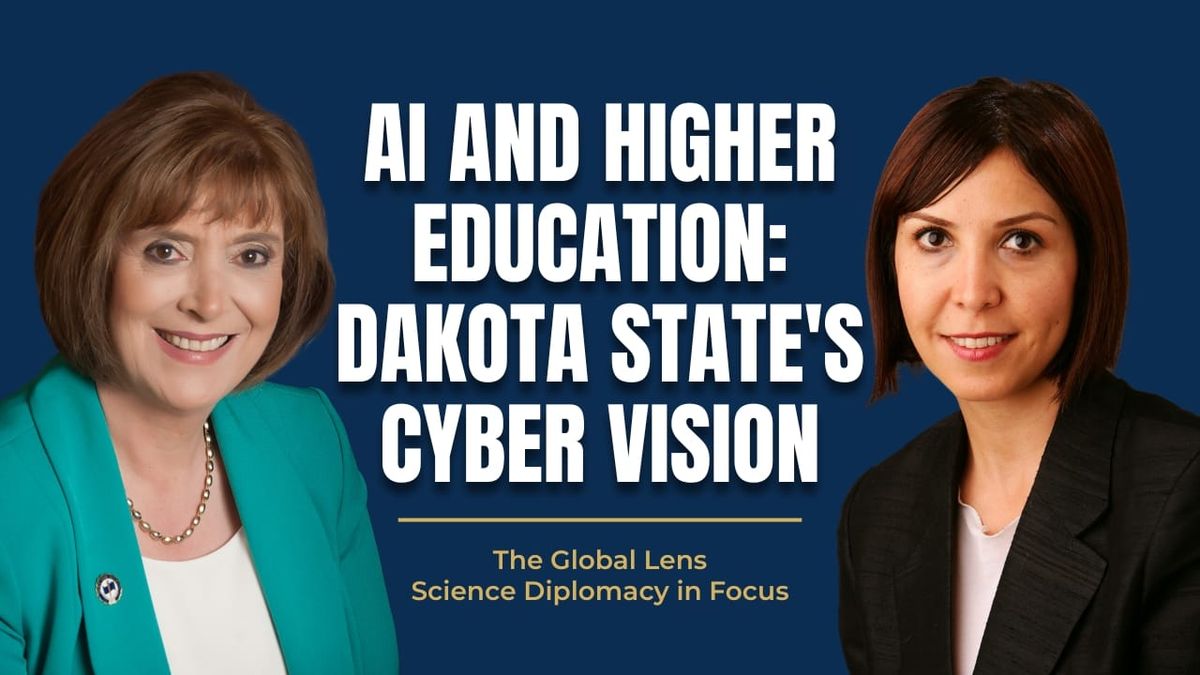
In this episode of The Global Lens: Science Diplomacy in Focus, I speak with Dr. Jose-Marie Griffiths, President of Dakota State University, about how a higher education institution based in the American Midwest has become a national and international reference point at the intersection of AI, cybersecurity, workforce development, and policy.
Our conversation explores how higher education institutions can function as science diplomacy in practice. Not as theory or rhetoric, but as operational platforms that build shared standards, ethical frameworks, and trusted collaboration so that AI advances innovation while benefiting society rather than controlling it.
🎧 Listen across major platforms: Spotify | Apple Podcasts | More Platforms
Key takeaways
AI leadership is demonstrated, not declared
AI leadership emerges through applied education, research, and service delivery that move ideas from concept to real-world impact.
Higher education institutions act as connective infrastructure
Applied labs, clinics, and innovation hubs connect government, industry, and international partners in ways that endure beyond political cycles.
Access underpins inclusive AI innovation
Programs spanning high school students, apprenticeships, and global exchanges expand participation while strengthening cyber resilience and trust.
Global standards emerge from collaboration, not silos
Effective AI governance depends on sustained engagement across government, industry, academia, and international institutions.
Education itself is science diplomacy
AI-native education shapes global norms, workforce capability, and long-term partnerships simultaneously.
Why this matters
As governments prioritize AI across national security, health, agriculture, energy, and critical infrastructure, education has become a strategic domain.
The Dakota State model shows how higher education institutions can accelerate innovation responsibly, strengthen cyber and data resilience, build trusted international partnerships, and translate research into operational and policy outcomes.
In an era where technological capability, geopolitical influence, and economic competitiveness are increasingly linked, institutions that connect science, policy, and markets will play a defining role in shaping global trajectories.
What we cover in this conversation
From cyber excellence to AI-native strategy
When Dr. Griffiths arrived at Dakota State University in 2015, the institution already held rare federal designations in cyber defense, cyber operations, and cyber research. Rather than protecting that position defensively, she expanded it through applied research and institutional integration.
That strategy led to the creation of Madison Cyber Labs, applied research environments focused on national security, public service, and industry needs. These labs became the foundation for integrating AI into cybersecurity, governance, workforce development, and policy engagement.
How AI is reshaping higher education itself
At Dakota State, AI is not confined to coursework. It shapes how the institution learns, researches, operates, and serves.
Initiatives such as the Google-supported Cybersecurity Clinic compress workforce development timelines from years into months. Partnerships with agencies including the National Security Agency, Department of Defense, National Science Foundation, and Army Cyber ensure that research translates into action.
With a comprehensive suite of degree programs spanning AI and cybersecurity, DSU teaches both AI for cybersecurity and cybersecurity for AI. This distinction is increasingly critical as AI systems become embedded in public decision-making and national infrastructure.
Empowering new participants in global AI innovation
Dr. Griffiths emphasizes that secure and responsible AI innovation must be inclusive to succeed.
Through cyber apprenticeships, high-school dual-credit programs, international partnerships, and the use of open AI tools, Dakota State expands access while building global trust. Collaborations with partners in Sweden, the European Union, the United Kingdom, Australia, Korea, and beyond demonstrate how applied education can serve as a durable platform for international cooperation, even amid geopolitical complexity.
Science diplomacy in action
Rather than treating diplomacy as an abstract concept, Dakota State operationalizes it through shared work.
Joint research teams, shared datasets, student and faculty mobility, and industry-driven problem solving form the basis of collaboration. These everyday practices establish common standards for transparency, ethics, and resilience, allowing innovation to advance while reinforcing trust.
In this way, higher education institutions become active diplomatic actors, shaping global norms through practice rather than proclamation.
Shaping global AI standards and data governance
According to Dr. Griffiths, the sectors best positioned to shape global AI frameworks are those that bring government, industry, and higher education institutions together.
U.S. institutions such as the Office of Science and Technology Policy, the National Institute of Standards and Technology, and the Special Competitive Studies Project, alongside international bodies like the OECD, provide forums where protection and innovation can advance simultaneously.
Dakota State contributes through applied research, workforce design, and ethical AI frameworks that span the full lifecycle of AI systems. From design and testing to deployment and use, responsibility is embedded throughout.
Lessons for policymakers and higher education leaders
For policymakers in Washington, Brussels, and emerging innovation hubs alike, the Dakota State approach offers a clear blueprint.
Start small and experiment early.
Prioritize AI literacy alongside technical skills.
Invest not only in workforce development, but in educators.
Embed responsibility across the full AI lifecycle.
When designed intentionally, education becomes a multiplier of national capability and international trust.
Featured guest
Dr. Jose-Marie Griffiths is President of Dakota State University, where she has led transformational growth since 2015. A physicist and information scientist by training, she has served on the National Science Board, the U.S. President’s Information Technology Advisory Committee, and the National Security Commission on Artificial Intelligence.
She currently advises the Special Competitive Studies Project (SCSP) and serves on the CNAS Task Force on AI and National Security. Her work spans collaborations with over 28 federal agencies, major corporations, NATO, and the United Nations.
She has been honored as USA Today’s Woman of the Year for South Dakota and named one of InspiredMinds’ 50 Influential Women in AI.
Action
Follow Global Lens Science Diplomacy in Focus and join Global Signals, our biweekly strategic brief delivering early insights on science, innovation, global markets, and international partnerships before they become headlines.
Listen to The Global Lens: Science Diplomacy in Focus across major platforms.
New Resource: The Science Diplomacy Playbook
For readers working across diplomacy, technology policy, research strategy, investment, or international partnerships, The Science Diplomacy Playbook: 2026 Edition is now available to order.
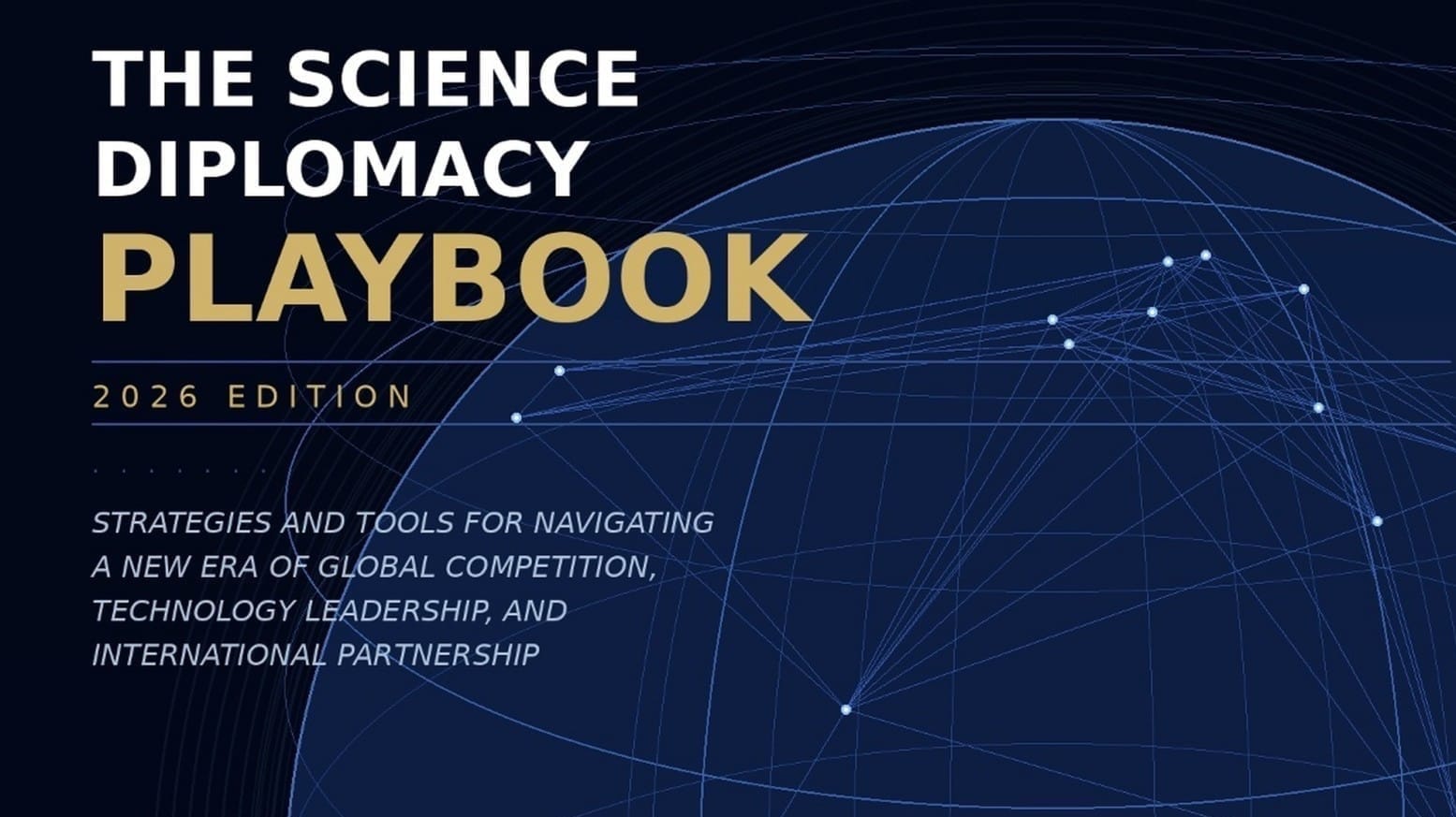
The guide expands on many of the themes covered in Global Signals, including AI governance, critical minerals diplomacy, bilateral science and technology agreements, minilateral coalitions, research security, and the growing role of science diplomacy in industrial strategy.
It is written as a practical field guide for decision makers navigating the intersection of science, technology, and global affairs.
Available as a paperback and kindle on Amazon, with ebook editions on Apple Books, Fable, and Everand. Library distribution rolling out across North America, the United Kingdom, and Europe through Tolino, Vivlio, Smashwords, Gardners, BorrowBox, and cloudLibrary.
Join Global Signals
A biweekly strategic brief and live briefing series translating science, technology, policy, and global capital flows into strategic insight for decision makers across diplomacy, investment, research, and innovation. Join here.
More analysis on science diplomacy and strategic infrastructure is available at glsd.ai, where ongoing work connects policy, innovation, and international partnerships through a global lens.