
Peter Agre on Science, Diplomacy, and the Rooms Politics Cannot Reach
The most important conversations in global diplomacy are not always happening in foreign ministries or at the United Nations. Sometimes they happen in a laboratory in Pyongyang, a research institute in Havana, or a conference room in Tehran, between scientists who share a language that can move across political divides.
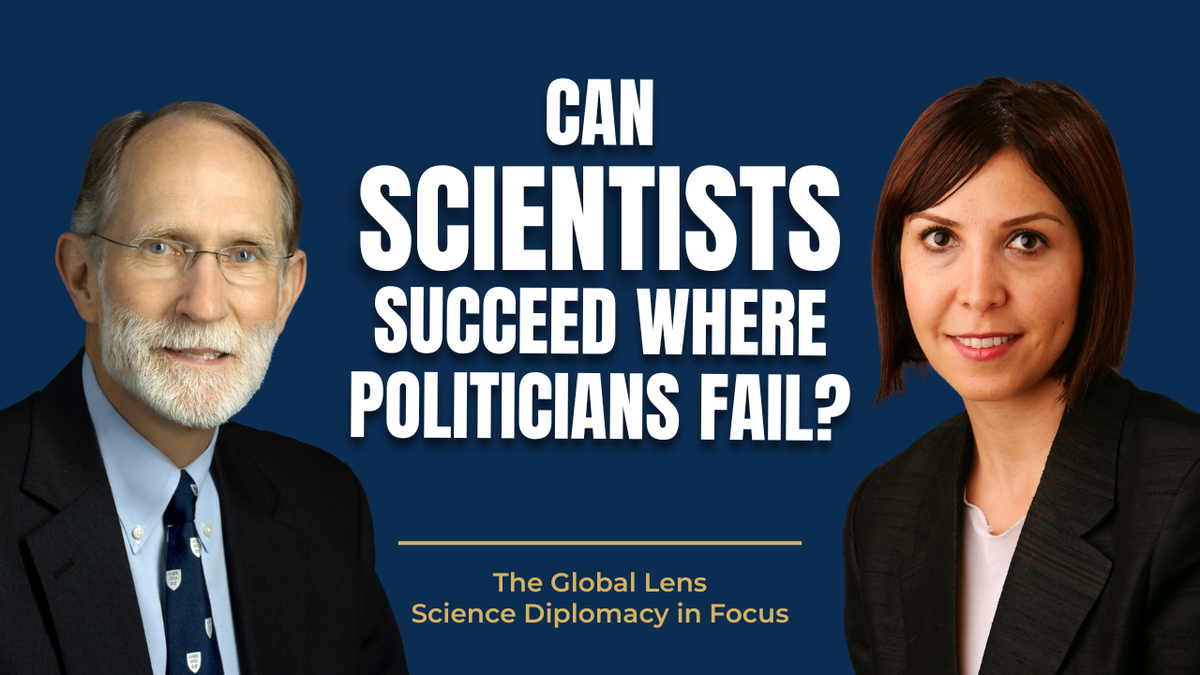
In this episode of The Global Lens: Science Diplomacy in Focus, I speak with Dr. Peter Agre, Nobel Laureate in Chemistry and former Director of the Johns Hopkins Malaria Research Institute, about what happens when scientists step into spaces where formal diplomacy often struggles to reach.
Drawing from his new book, Can Scientists Succeed Where Politicians Fail?, co-authored with Dr. Seema Yasmin, Dr. Agre reflects on decades of scientific diplomacy and why this work matters more urgently now than ever.
🎧 Listen across major platforms: Spotify | Apple Podcasts | More Platforms
Key Takeaways
Curiosity and empathy are the foundations of science diplomacy
Before strategy and before credentials, it is the genuine desire to understand another person’s reality that opens doors. Dr. Agre’s approach has always begun there.
Science creates trust where politics creates walls
In North Korea, Cuba, and Iran, shared scientific inquiry established channels of dialogue that no formal diplomatic process could easily replicate. Evidence and method became a common grammar.
Recognition brings responsibility
The Nobel Prize gave Dr. Agre a global platform. He chose to use it not for prestige, but for access: to rooms, conversations, and moments where cooperation was still possible.
Protecting openness is itself a form of diplomacy
Institutions that defend the free exchange of scientific knowledge are doing diplomatic work, whether or not they define it that way. The current climate of suspicion toward international researchers puts that infrastructure at risk.
The next generation is the long game
One third of American Nobel Prize winners since World War II were born outside the United States. Mentorship, mobility, and openness are not soft values. They are strategic investments.
We are more alike than we are different
This is not a platitude in Dr. Agre’s telling. It is a conclusion drawn from years of sitting across the table from people the world described as adversaries.
Why This Matters
We are living through a period of accelerating geopolitical fragmentation. Scientific collaboration, once treated as relatively insulated from political disruption, is now navigating export controls, visa restrictions, funding nationalism, and growing suspicion toward international researchers.
Against this backdrop, Dr. Agre’s life’s work offers something rare: evidence that person-to-person engagement, built through science, can sustain trust across even the deepest political divides.
This is not naive optimism. It is a documented, practiced, and replicable methodology, one that higher education institutions, research funders, and policymakers would be wise to protect and expand rather than quietly erode.
What We Cover in This Conversation
From molecular biology to global envoy
Dr. Agre’s scientific career began with a foundational discovery: aquaporins, the protein channels that allow water to move through cell membranes, a finding that earned him the 2003 Nobel Prize in Chemistry. But equally significant is how that recognition became a platform for global engagement. Rather than retreating into academic prestige, he stepped outward, accepting invitations to engage in places where American scientists were rarely welcomed.
Science as a language of trust in politically divided places
His accounts of scientific exchanges in North Korea, Cuba, and Iran reveal something consistent: when genuine curiosity was extended, it was often met. Scientists across geopolitical divides are not abstractions. They are researchers trying to solve problems, train students, and contribute to human knowledge. That shared orientation creates real, if fragile, openings.
Lessons in humility from the field
Dr. Agre is candid about what science diplomacy requires in practice, not the performance of authority, but the willingness to listen, to learn local context, and to resist the temptation to arrive with ready-made answers. Respect, in his view, must be genuine to be effective.
Institutions as guardians of openness
Organizations like the American Association for the Advancement of Science, which Dr. Agre formerly led as President, play a structural role in sustaining global scientific networks. He speaks to the importance of institutions holding the line on openness, access, and inclusion, particularly when the political environment is pushing in the opposite direction.
Mentorship and the next generation
For Dr. Agre, science diplomacy is also an educational practice. Young scientists who participate in international exchanges do not just return with data. They return with friendships, perspective, and a lasting orientation toward global cooperation. Some remain in the United States and become leaders. Others return home and carry that same orientation with them. Both outcomes matter.
Science diplomacy as a charitable act
One of the most striking moments in our conversation comes when Dr. Agre describes this work not as a career strategy, but as something closer to a moral commitment. None of the diplomatic engagements he undertook came with a salary. The reward was the quiet confidence of doing something that matters, even if its full benefits only become visible much later.
Lessons for Policymakers and Research Leaders
For those in Washington, Brussels, and other innovation capitals navigating the tension between national security and international scientific openness, Dr. Agre’s experience offers a clear signal.
Treating foreign-born researchers primarily through a lens of suspicion does not strengthen scientific leadership or long-term national competitiveness. It weakens the very ecosystem that has made American science, and by extension American influence, a global asset for decades.
Protect scientific mobility. Invest in exchanges. Welcome scientists who arrive from elsewhere. The returns are measured not only in papers and patents, but in relationships, credibility, and goodwill that no policy instrument can manufacture from scratch.
Featured Guest
Dr. Peter Agre was awarded the 2003 Nobel Prize in Chemistry for his discovery of aquaporins. He is a physician, molecular biologist, and Director of the Johns Hopkins Malaria Research Institute. As former President of the American Association for the Advancement of Science, he has led scientific delegations to some of the world’s most politically isolated countries. His new book, Can Scientists Succeed Where Politicians Fail?, is published by Johns Hopkins Press
Action
Join Global Signals : A biweekly strategic brief and live briefing series translating science, technology, policy, and global capital flows into strategic insight for decision makers across diplomacy, investment, research, and innovation. Join here
🎧 Podcast: Don’t miss The Global Lens, Science Diplomacy in Focus, featuring global leaders at the intersection of science, diplomacy, and innovation.
Subscribe: Spotify | Apple | More platforms
New Resource: The Science Diplomacy Playbook
For readers working across diplomacy, technology policy, research strategy, investment, or international partnerships, The Science Diplomacy Playbook: 2026 Edition is now available to order.
The guide expands on many of the themes covered in Global Signals, including AI governance, critical minerals diplomacy, bilateral science and technology agreements, minilateral coalitions, research security, and the growing role of science diplomacy in industrial strategy.
It is written as a practical field guide for decision makers navigating the intersection of science, technology, and global affairs.
Available as a paperback and kindle on Amazon, with ebook editions on Apple Books, Fable, and Everand. Library distribution rolling out across North America, the United Kingdom, and Europe through Tolino, Vivlio, Smashwords, Gardners, BorrowBox, and cloudLibrary.
More analysis on science diplomacy and strategic infrastructure is available at glsd.ai, where ongoing work connects policy, innovation, and international partnerships through a global lens.