Technological Sovereignty & Geopolitics

The 2026 Emerging Tech Symposium at Johns Hopkins SAIS opened at the Johns Hopkins Bloomberg Center in Washington, D.C., with a defining question for this moment: what does technological sovereignty actually mean in 2026, and how is it reshaping global power, policy, and markets?
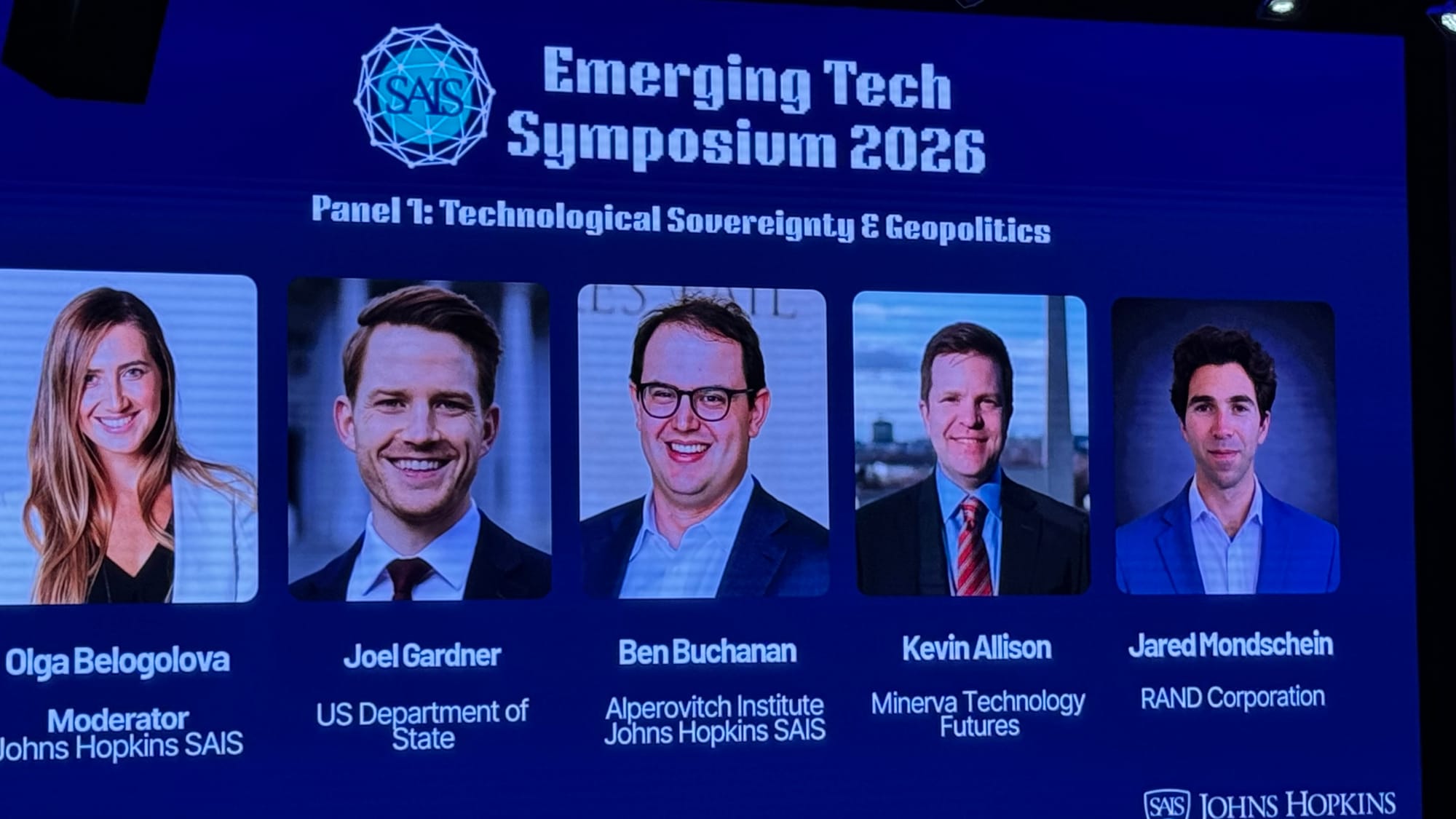
The opening panel, “Technological Sovereignty & Geopolitics,” set the tone for the day. Moderated by Olga Belogolova, Director of the Emerging Technologies Initiative at Johns Hopkins SAIS, the discussion brought together Joel Gardner, Deputy Assistant Secretary for Emerging Technology at the U.S. Department of State; Ben Buchanan, Assistant Professor at Johns Hopkins SAIS and former White House Special Advisor for AI; Kevin Allison, President and Founder of Minerva Technology Futures and Nonresident Fellow at the Center for European Policy Analysis; and Jared Mondschein, Physical Scientist at RAND Corporation.
What emerged from the conversation was not a narrow definition of sovereignty, but a reframing of how technology systems, alliances, and economic strategy are evolving together.
Technological sovereignty is no longer about independence. It is about the ability to operate, compete, and secure national interests within an interconnected system where dependencies are unavoidable but must be managed deliberately. The discussion made clear that full strategic autonomy is neither realistic nor necessarily desirable. The global technology ecosystem was built on decades of integrated supply chains, shared research, cross-border capital, and talent mobility. The shift underway is not toward isolation, but toward selective resilience.
This is where the concept of trusted systems and trusted partners becomes central.
A key theme throughout the panel was the transition from an era defined by efficiency to one defined by security, reliability, and alignment among allies. For decades, global technology systems optimized for cost, speed, and scale. That model is now being re-evaluated in light of geopolitical competition, supply chain vulnerabilities, and the strategic importance of technologies such as AI and semiconductors.
Governments are increasingly focused on understanding where critical dependencies lie, particularly across the full technology stack. That includes not only AI models and applications, but also compute infrastructure, semiconductor fabrication, critical minerals, energy systems, and data center capacity. Each layer introduces different risks, different actors, and different policy challenges.
This layered understanding is shaping how partnerships are being built.
Rather than attempting to replicate entire supply chains domestically, the emphasis is on working with trusted democratic partners to create resilient, interoperable systems. This includes coordination on standards, investment strategies, and supply chain diversification. Initiatives emerging from the U.S. policy landscape reflect this approach, including efforts to align public and private capital, engage sovereign wealth partners, and invest in critical areas such as semiconductor capacity and materials processing.
At the same time, the panel underscored that the private sector remains the primary driver of innovation. Governments are not replacing markets, but they are increasingly shaping the conditions under which markets operate. This introduces a central tension between maintaining the dynamism of a technology ecosystem built on shareholder-driven incentives and addressing the growing need for resilience, redundancy, and long-term strategic security, a balance that is still evolving and not yet fully resolved.
The discussion also pointed to the reality that technological leadership is not guaranteed, even for countries that currently hold an advantage. The United States retains significant strengths across AI, including talent, capital markets, research institutions, and compute infrastructure. However, those advantages depend on policy choices. Talent flows, energy capacity, infrastructure investment, and regulatory clarity all play a role in determining whether leadership is sustained or eroded.
Energy, in particular, is emerging as a defining constraint. As AI systems scale, the demand for compute and data center infrastructure is directly tied to power availability. This links technology policy to energy policy in ways that are becoming increasingly difficult to separate.
The conversation also offered a clear view of how different regions are approaching this moment.
Europe’s model, long centered on regulation and standards-setting, is being reassessed in light of its limited presence in frontier AI and cloud platforms. Structural factors such as energy costs, fragmented capital markets, and limited risk-taking capacity are shaping its position. At the same time, Europe continues to play a role in areas such as advanced manufacturing and regulatory frameworks, raising broader questions about how different governance models translate into technological competitiveness.
In contrast, the United States is increasingly positioning itself as the hub of a democratic technology ecosystem, working with partners such as Japan, South Korea, and Taiwan. This ecosystem is not only about innovation, but also about shared standards, secure supply chains, and coordinated approaches to risk.
Within this context, standards emerged as a strategic lever, not as constraints on innovation, but as enablers of scale, trust, and global adoption. Aligning standards across trusted partners allows systems to interoperate, reduces uncertainty for companies, and creates a foundation for broader market integration, particularly in AI where safety, transparency, and accountability are directly tied to public trust and long-term adoption.
Trust became one of the most important underlying themes of the discussion.
Technological systems can only function at scale if there is trust between partners, between governments and companies, and between systems themselves. Yet trust is also one of the most fragile elements in the current geopolitical environment. As countries move toward more selective forms of interdependence, questions of alignment, reliability, and political stability become central to how partnerships are structured.
As the discussion progressed, it moved beyond abstract policy into real-world implications, underscoring how quickly these issues translate into operational and security considerations.
Audience questions highlighted the growing intersection between digital infrastructure and physical risk. The expansion of AI infrastructure in regions such as the Middle East, for example, is now being assessed not only through economic and technological lenses, but also through security considerations, including exposure to geopolitical instability and kinetic threats. This introduces a new dimension to infrastructure planning, where resilience must account for both cyber and physical vulnerabilities.
At the same time, competition with China remains a defining factor shaping strategy.
The discussion pointed to the importance of compute, semiconductors, and supply chains as areas where the United States and its partners currently hold an advantage. However, that advantage depends on continued coordination and enforcement. Concerns were also raised about the diffusion of capabilities through open-source systems and the potential for strategic competitors to leverage those pathways.
Beyond direct competition, technological capabilities are increasingly being used as tools of diplomatic leverage. Access to AI infrastructure, compute, and advanced systems is becoming part of how countries build influence, negotiate partnerships, and shape alignment across regions.
What this opening panel made clear is that technological sovereignty is no longer a theoretical or purely technical concept. It is a system-level challenge that sits at the intersection of infrastructure, capital, energy, talent, and geopolitics.
The central question is not whether countries are interdependent. That is already the case. The question is how that interdependence is structured, who it is built with, and whether it reinforces resilience or creates vulnerability.
That framing set the tone for the 2026 Emerging Tech Symposium and for the broader conversations now unfolding across governments, industry, and international institutions.
More analysis on science diplomacy and strategic infrastructure is available at glsd.ai, where ongoing work connects policy, innovation, and international partnerships through a global lens.
New Resource: The Science Diplomacy Playbook
For readers working across diplomacy, technology policy, research strategy, investment, or international partnerships, The Science Diplomacy Playbook: 2026 Edition is now available to order.
The guide expands on many of the themes covered in Global Signals, including AI governance, critical minerals diplomacy, bilateral science and technology agreements, minilateral coalitions, research security, and the growing role of science diplomacy in industrial strategy.
It is written as a practical field guide for decision makers navigating the intersection of science, technology, and global affairs.
Available as a paperback and kindle on Amazon, with ebook editions on Apple Books, Fable, and Everand. Library distribution rolling out across North America, the United Kingdom, and Europe through Tolino, Vivlio, Smashwords, Gardners, BorrowBox, and cloudLibrary.
Join Global Signals
A biweekly strategic brief and live briefing series translating science, technology, policy, and global capital flows into strategic insight for decision makers across diplomacy, investment, research, and innovation. Join here.