The AI Governance Gap: What the UN Secretary General’s Statement Did Not Yet Address
Why governing artificial intelligence requires moving beyond rules and safeguards toward a broader architecture of science, technology, infrastructure, and diplomacy.
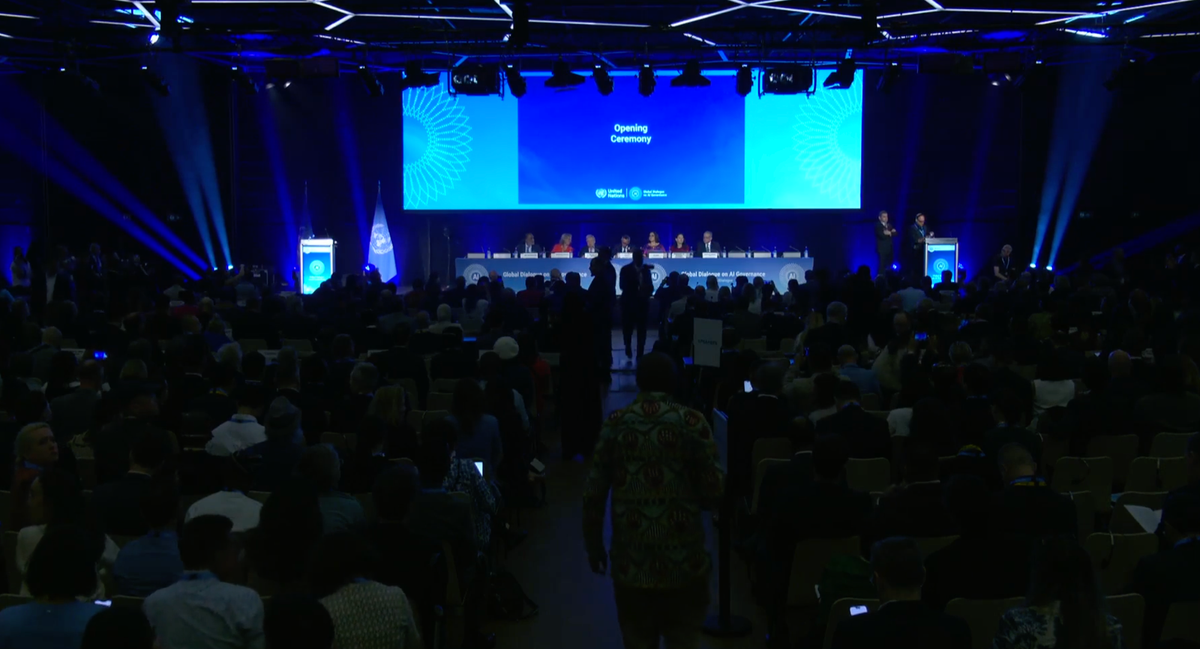
The UN Secretary General’s remarks at the opening of the first Global Dialogue on Artificial Intelligence Governance rightly underscored foundational imperatives: international cooperation, accountability, inclusion, safety, and the development of shared approaches. These are essential starting points. António Guterres highlighted AI’s “runaway speed,” the concentration of computing power, data, and talent among a small number of companies and countries, the erosion of truth in an era of machine-generated misinformation, risks to children, environmental impacts, and the need to address lethal autonomous weapons. He called for common safety baselines, an AI Child Safety Pledge, a Global Network and Fund for capacity building, and greater transparency on AI’s resource footprint.
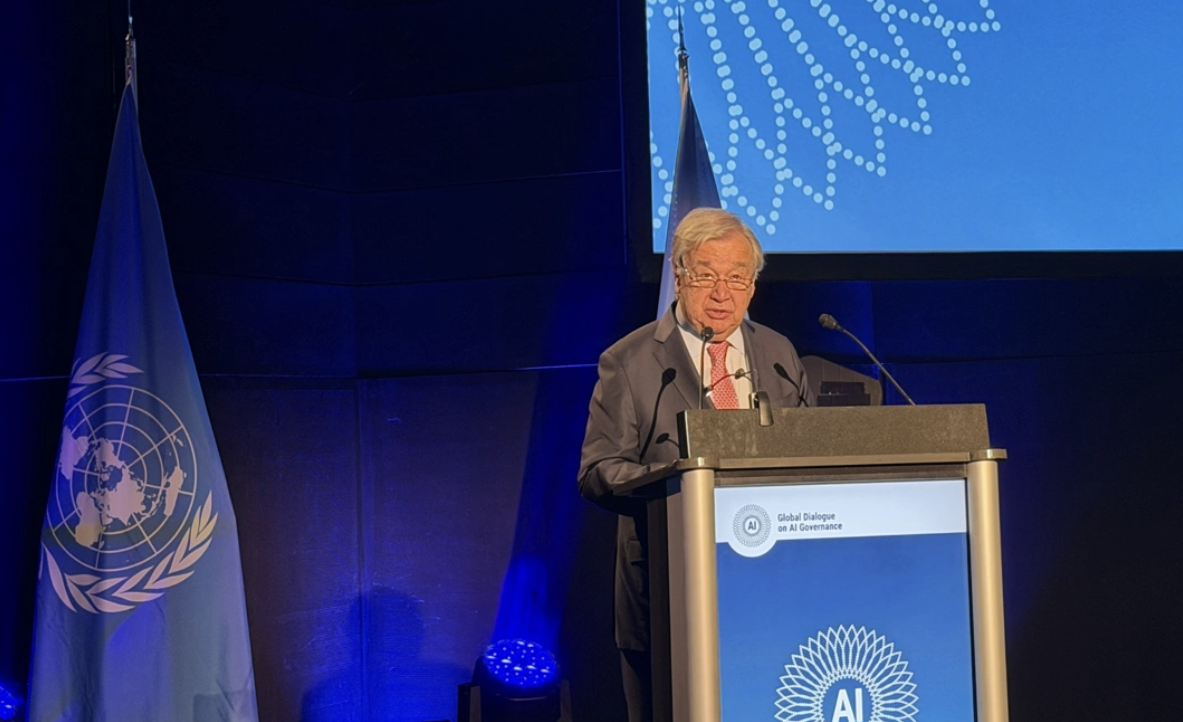
António Guterres, United Nations Secretary-General, delivering remarks at the First Global Dialogue on AI Governance.
Yet the statement also illuminates a deeper structural challenge. AI is not merely a governance problem to be addressed through traditional multilateral negotiations among states. It represents a transformation of the systems that determine technological power and geopolitical influence: scientific capacity, computing infrastructure, energy resources, advanced manufacturing, talent pipelines, and global innovation networks.
Many twentieth-century governance frameworks were built around states negotiating rules and agreements. AI evolves through a far broader and more dynamic ecosystem, one in which governments, private companies, universities, researchers, investors, civil society, and international institutions all shape outcomes in real time. As the Secretary General warned, AI development is unfolding at extraordinary speed, with systems increasingly capable of generating code and making decisions with diminishing levels of direct human oversight.
The central question for the AI era is not whether multilateral institutions remain relevant; they do. The question is whether existing models are sufficient for a world in which technological capability has become a defining determinant of economic strength, scientific leadership, and geopolitical influence.
This does not mean that the United Nations should become an institution for directing technological development or managing national innovation strategies. Its role is not to decide who builds computing infrastructure, controls advanced technologies, or leads research ecosystems. Its unique value is different: creating a trusted space where the realities shaping AI can be addressed collectively.
Effective AI governance cannot be separated from the conditions that determine technological capability. The concentration of computing power, scientific expertise, infrastructure, energy resources, and innovation capacity will influence not only how AI is developed, but who is able to participate in shaping its future.
The challenge is that many governance approaches still reflect the institutional logic of the twentieth century, when states were the primary actors shaping global outcomes. The AI era requires a broader lens, one that preserves the importance of multilateralism while incorporating the scientific, technological, economic, and social systems that increasingly influence global power.
The challenge is not to replace multilateralism, but to evolve it for a world where scientific capability and technological infrastructure increasingly shape global affairs alongside traditional diplomacy.
This is precisely where an expanded form of science diplomacy becomes indispensable. As Rui Pedro Duarte, author of Statecraft 3.0: The Age of AI Diplomacy, argued in our conversation on The Global Lens | Science Diplomacy in Focus, AI is not only changing technology; it is changing the practice of diplomacy itself.
The next generation of statecraft must become more connected, adaptive, and ecosystem oriented, bringing together governments, scientists, industry, universities, and international institutions. Science diplomacy must foster not only rule making, but also proactive collaboration on capacity building, infrastructure partnerships, talent development, and trusted innovation networks, particularly to prevent the AI divide from becoming a permanent gap in development, security, and technological sovereignty.
Three areas warrant stronger emphasis
1. Addressing power concentration at its roots
Beyond safety standards and red lines, deliberate strategies are needed to expand access to frontier capabilities through international scientific partnerships, shared computing resources, and talent development, aligning with proposals for global capacity building.
2. Integrating technological foresight into diplomacy
Governance must anticipate how AI intersects with energy, critical minerals, advanced manufacturing, and dual-use technologies, rather than treating AI in isolation.
3. Building hybrid institutions and norms
Future models should combine governmental leadership with expertise from the scientific community, industry, and civil society, while ensuring developing countries have meaningful influence in shaping the future.
The Global Dialogue represents an important step toward evidence-based and inclusive direction setting. But translating principles into coordinated action will require science diplomacy that operates at the pace and complexity of AI itself: agile, ecosystem-oriented, and focused on shaping technological power for shared benefit rather than default concentration.
The future of AI governance will not be defined only by the rules we create, but by the ecosystems we build to support scientific collaboration, technological capacity, and trusted innovation.
Closing the AI governance gap demands urgency: governance by design, not drift by default.
Join Global Signals
A biweekly strategic brief and live briefing series translating science, technology, policy, and global capital flows into strategic insight for decision makers across diplomacy, investment, research, and innovation. Join here.