AI, Artemis, and the New Space Infrastructure Economy

AI, Artemis, and the New Space Infrastructure Economy
Photo credits: Daniella Sussman

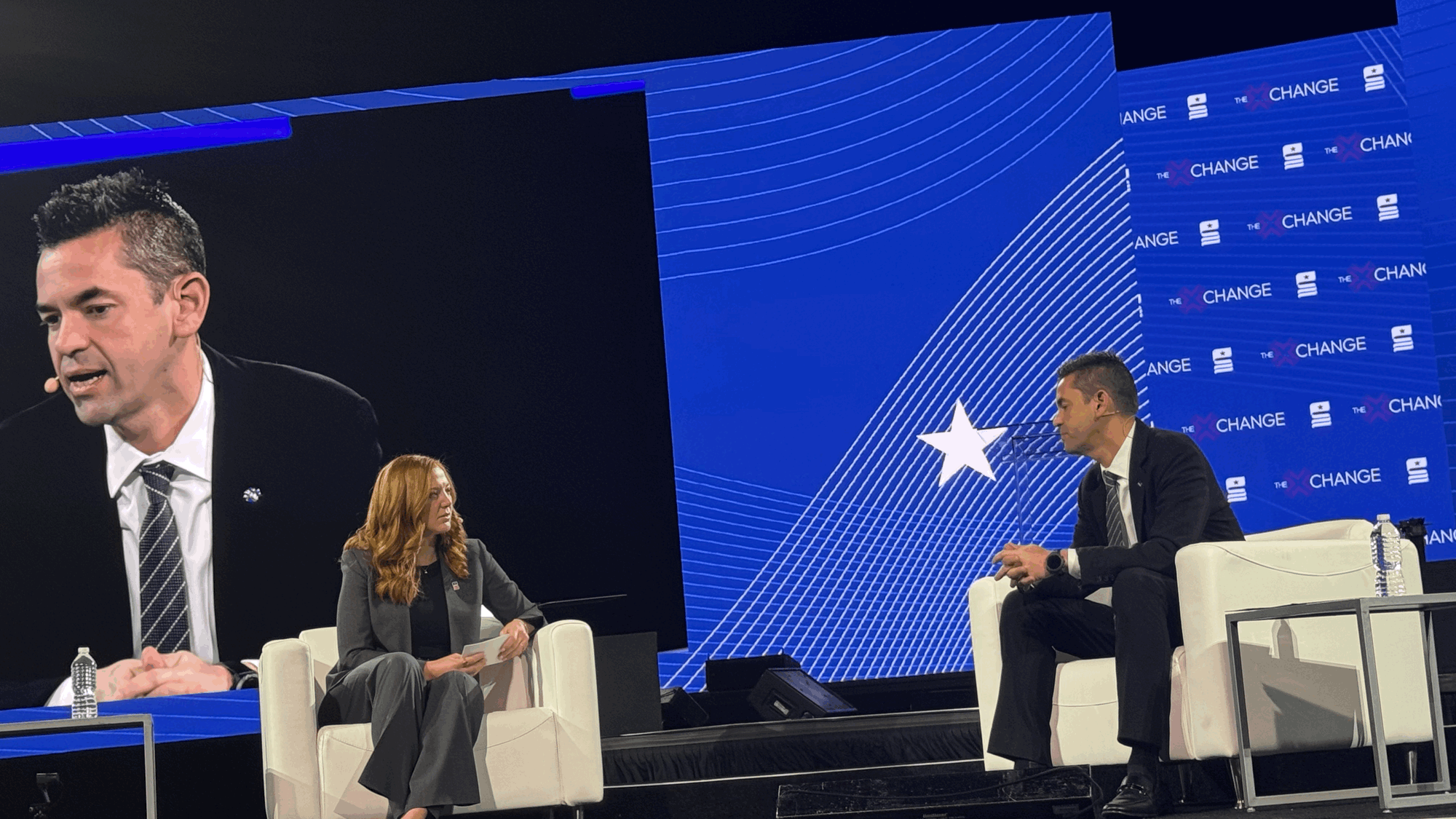
When four astronauts rounded the far side of the Moon aboard Artemis II and returned home safely, the world paused. For a moment, the noise of geopolitical competition stilled, and humanity watched something rare: a genuine feat of collective ambition, executed at the frontier of what is physically possible. It was also an opening act, and NASA Administrator Jared Isaacman framed it plainly at The Exchange during the SCSP AI+ Expo 2026. "After a brief 54-year intermission, NASA is back in the business of sending astronauts to the moon."

Artemis II sent its crew farther into deep space than any humans in history, and that milestone now serves as the baseline from which everything accelerates. At Kennedy Space Center, Artemis III is already in assembly. The SLS core stage arrived in late April by barge from NASA's Michoud Assembly Facility in New Orleans and is now undergoing core stage assembly operations in High Bay 2 of the Vehicle Assembly Building. Teams are beginning to stack solid rocket boosters, while engineers prepare the Orion spacecraft, including temporary installation of solar array wings ahead of deep field acoustic testing. When ready, Artemis III will enter low-Earth orbit to test interoperability with commercial landers, and in 2028, Artemis IV will return Americans to the lunar surface. Isaacman was unambiguous about what makes this moment different from anything that came before: "This time, we are going back to stay." The mission is no longer about short visits or symbolic landings, but about permanent infrastructure.

Infrastructure Is the Strategy

One of the clearest signals coming out of the AI+ Expo 2026 was that space is no longer a standalone sector. That signal came through directly in the Exchange conversation titled "NASA Administrator Jared Isaacman on Space and the Next American Frontier," featuring Administrator Isaacman in conversation with Maj. Megan Hainline, United States Air Force Fellow at SCSP. Space is increasingly woven into the same strategic fabric as AI systems, energy infrastructure, compute capacity, autonomous operations, advanced manufacturing, and communications resilience. The Artemis ecosystem, viewed through that lens, is not simply a lunar return program. It is a long-horizon infrastructure framework involving commercial participation, robotics, scientific platforms, logistics architecture, and operational environments where AI will be load-bearing. The question is whether governance frameworks, partnership models, and science diplomacy architecture can keep pace.

Now, NASA is developing something that sharpens the argument further: SR1 Freedom, a spacecraft NASA describes as the first nuclear-powered vehicle designed for interplanetary travel. Isaacman outlined this as part of a broader vision that moves well beyond flags and footprints toward a sustained lunar presence with power, communications, mobility, and habitation infrastructure, all positioned as preparation for crewed Mars missions. That framing is deliberate: a capability that no other company, agency, or country is positioned to accomplish, and a signal about where the frontier is being drawn, and who intends to hold it.

What This Means for Science Diplomacy

The United States has stated explicitly that it intends to lead on the lunar surface alongside international allies and commercial partners, and that framing creates a critical window for science diplomacy practitioners to understand. The architecture of sustained lunar presence will require international coordination, technical standards, shared data systems, research frameworks, and trusted supply chains. These are not peripheral considerations. They are the infrastructure beneath the infrastructure, and the countries and institutions that shape those agreements, norms, and partnerships early will hold structural advantages for decades.

AI amplifies this dynamic. The future competition around artificial intelligence may not revolve primarily around software dominance. It will also depend on who builds, coordinates, and sustains the ecosystems that support the next generation of scientific, industrial, and space capabilities. Compute, energy, secure communications, trusted hardware, and eventually lunar-based operational environments are all part of that equation.

The Strategic Layer No One Is Talking About Enough

What remains underexamined in most policy and science diplomacy conversations is the governance gap forming beneath this acceleration. The Artemis Accords have reached 67 signatories as of May 2026, a meaningful signal of the breadth of U.S.-led norms in space. But the Accords remain non-binding and notably absent of both China and Russia, which means the operational questions around commercial lander interoperability, data sovereignty, scientific access, resource utilization, and AI-enabled autonomous systems on the lunar surface are advancing faster than the multilateral frameworks designed to govern them. That gap is where the most consequential science diplomacy work of the next decade will occur.

As the United States moves toward 2028 and the first crewed lunar landing since 1972, the question for science diplomacy is not whether this moment matters. The question is whether the international community is building the governance architecture, the partnership frameworks, and the institutional capacity fast enough to match the pace of what is being assembled in High Bay 2 right now. The rocket is already on the floor.


Join Global Signals

A biweekly strategic brief and live briefing series translating science, technology, policy, and global capital flows into strategic insight for decision makers across diplomacy, investment, research, and innovation. Join here


New Resource: The Science Diplomacy Playbook

For readers working across diplomacy, technology policy, research strategy, investment, or international partnerships, The Science Diplomacy Playbook: 2026 Edition is now available to order.

The guide expands on many of the themes covered in Global Signals, including AI governance, critical minerals diplomacy, bilateral science and technology agreements, minilateral coalitions, research security, and the growing role of science diplomacy in industrial strategy.

It is written as a practical field guide for decision makers navigating the intersection of science, technology, and global affairs.

Available as a paperback and kindle on Amazon, with ebook editions on Apple Books and Google Play. Expanded ebook and library distribution is rolling out across North America, the United Kingdom, and Europe, including through Tolino, Vivlio, Smashwords, Fable, Gardners, BorrowBox, and cloudLibrary.


Join Global Signals

A biweekly strategic brief and live briefing series translating science, technology, policy, and global capital flows into strategic insight for decision makers across diplomacy, investment, research, and innovation. Join here.


More analysis on science diplomacy and strategic infrastructure is available at glsd.ai, where ongoing work connects policy, innovation, and international partnerships through a global lens.