
Thilo Stadelmann on Pro-Human AI, Trust, and the Technology We Deserve
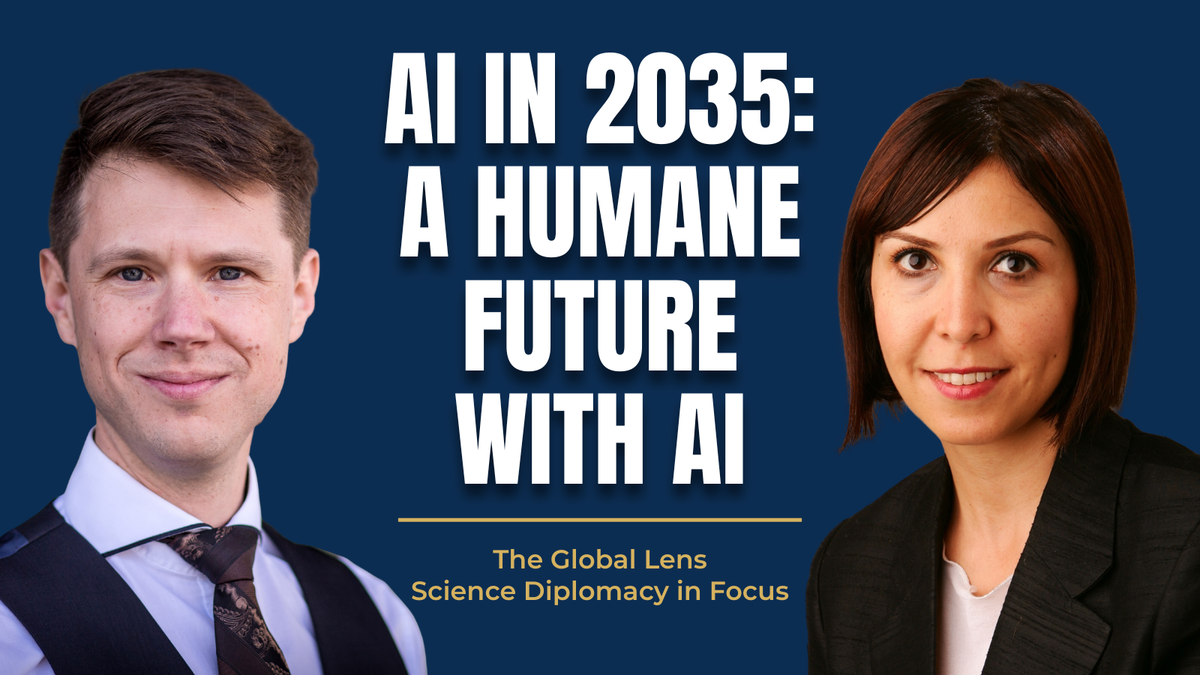
The dominant narrative in AI governance assumes we are racing toward artificial general intelligence and that the central task of policymakers is to manage that existential risk. Thilo Stadelmann, AI researcher, co-founder of AlpineAI, and Founding Director of the ZHAW Center for Artificial Intelligence , believes that narrative is not only wrong. It is actively distorting the choices that matter most right now.
For science diplomacy, the question is not only how AI is governed, but who gets to shape the systems that will mediate knowledge, trust, security, and public decision-making across borders. That question is already being answered, largely by a small number of companies in a small number of cities, on behalf of everyone else.
In this episode of The Global Lens: Science Diplomacy in Focus, Thilo lays out a different framework, one grounded in evidence, scenario-based thinking, and a clear-eyed view of what current AI systems can and cannot do. The conversation covers the contested assumptions behind AGI timelines, the emerging trust economy, digital sovereignty, and what a genuinely pro-human AI future looks like in practice.
🎧 Listen across major platforms: Spotify | Apple Podcasts | More Platforms
Key Takeaways
AGI timelines are being treated as science, but much of the debate is still speculative. The majority of AI researchers do not believe AGI is imminent. Those who predict it most loudly cannot point to technical evidence. What drives their forecasts, as Thilo explains, is a worldview shaped by science fiction narratives rather than the actual trajectory of machine learning research. Policy built on that foundation is policy solving the wrong problem.
The compute bet may not pay off as promised. Hundreds of billions of dollars are flowing into compute clusters on the premise that whoever builds AGI first wins the economy. Thilo argues that the more plausible outcome is a significant reallocation of that infrastructure toward applied use cases in health, climate, and scientific research. The physical capacity will exist. The question is whether the institutions and incentives are in place to direct it well.
AI is shifting something in our human core. Because we interact with AI through language, it mimics the texture of human relationships in ways no previous technology has. That proximity creates risks to our social fabric and mental health that are only beginning to be measured. Thilo points to emerging research on AI-induced psychological harm as an early signal of a pattern we have seen before with social media and have not yet learned to address upstream, through design rather than reaction.
Trust is the defining strategic variable of the AI era. Digital assistants are moving toward managing the majority of our digital lives. They will know not just our documents and schedules, but our thoughts, because we will tell them. The trustworthiness of those systems is no longer a product feature. It is a matter of personal and national security. As Thilo puts it: it might have been optional before. It is not optional anymore.
The intelligence layer is becoming a commodity. Scaling laws are flattening and the gap between frontier models and open-source alternatives is closing faster than the market expected. As the intelligence layer commoditizes, the trillion-dollar barrier to entry collapses. Value creation shifts to the product layer, and strong AI products can be built by small teams anywhere on Earth.
Public procurement is the underused lever. Governments represent a significant share of AI purchasing power. Requirements for pro-human certification as a condition of procurement create a market pull toward trustworthy, open, non-addictive technology. That pull is more durable than regulatory mandates and does not require waiting for legislation.
Why This Matters
We are at an inflection point in AI development. Scaling laws are flattening. The race for AGI is beginning to look like what Thilo describes: enormous sums of capital flowing into infrastructure that may not deliver what was promised.
What comes after that moment is not yet determined. The institutions, diplomats, and policymakers who act in this window will have disproportionate influence over the trajectory that follows. Thilo's scenario-based framework offers a practical, evidence-grounded way to think about that responsibility.
What This Means for Science Diplomacy
AI governance is rapidly becoming a domain of international negotiation. Trust frameworks, certification standards, procurement criteria, and data sovereignty agreements are not technical details. They are the new terrain of diplomatic engagement.
Science diplomats are uniquely positioned to bridge the technical and political dimensions of these conversations. The same skills that enable engagement across geopolitical divides, deep domain knowledge, credibility with both research communities and government interlocutors, and comfort with complexity, are precisely what AI governance negotiations will require. The question is whether science diplomacy institutions are moving fast enough to claim that space.
What This Means for Governments
Ministries and procurement agencies do not need to wait for international consensus to begin shaping the AI market. By requiring that systems used in public administration meet pro-human design standards, governments create immediate demand signals that the market will respond to. Thilo points to digital sovereignty concerns in Switzerland and Europe as examples of how national and regional priorities are already beginning to reshape vendor relationships and procurement criteria. Those early moves matter more than they may appear.
What This Means for Emerging Economies
The conventional assumption is that countries without massive compute infrastructure are locked out of the AI economy. Thilo's analysis challenges that directly. As open-source models improve and the cost of tailoring existing models falls, the geography of AI innovation expands significantly. Local teams building for local industries, public administrations, and governance frameworks do not need frontier model capabilities. They need good engineers, a clear use case, and access to models that are already being given away. That combination is available to a much wider range of countries than the current narrative suggests.
What We Cover in This Conversation
The evidence behind AGI skepticism
Thilo explains why the same fundamental paradigm has governed machine learning for seven decades, what that means for the credibility of near-term AGI predictions, and what a genuinely new paradigm would require.
Scenario-based thinking as a policy tool
His 2035 scenario work is not a forecast. It is a structured exploration of what becomes possible under plausible assumptions. He explains why this approach is more useful to policymakers than either optimistic projections or apocalyptic warnings.
Pro-human AI as a design discipline
The difference between technology that serves us and technology that extracts from us is not ethics. It is design choices made upstream. Thilo draws on the Star Trek computer as an unlikely but clarifying model: helpful, unsentimental, and non-addictive by design.
Digital sovereignty and the geopolitics of AI
Europe's emerging focus on digital sovereignty is a rational response to the concentration of AI capability in a small number of vendors. Thilo connects this to anti-monopoly logic and the long-term sustainability of the AI market globally.
The democratization of AI development - As the intelligence layer commoditizes and open-source alternatives improve, the geography of meaningful AI innovation expands. Thilo maps out a near-term future in which strong products are built by small teams anywhere in the world, serving local needs and local governance frameworks.
Featured Guest
Thilo Stadelmann is a professor and AI researcher at ZHAW, where he serves as Founding Director of the ZHAW Center for Artificial Intelligence, and co-founder of AlpineAI, a Swiss sovereign AI platform for regulated industries. His research focuses on machine learning, neural networks, and the societal implications of AI systems. He is the author of scenario work on AI in 2035 and a TEDx speaker on how not to fear artificial intelligence.
Action
Follow Global Lens Science Diplomacy in Focus and join Global Signals, our biweekly strategic brief delivering early insights on science, innovation, global markets, and international partnerships before they become headlines.
Listen to The Global Lens: Science Diplomacy in Focus across major platforms.
Global Lens Science Diplomacy in Focus is a curated platform for insight, dialogue, and connection at the intersection of science, innovation, diplomacy, and global markets.
We connect innovators, diplomats, policymakers, investors, and research leaders through analysis, dialogue, convening, and events to advance the next era of international partnerships.