
Building America's Internet of Science
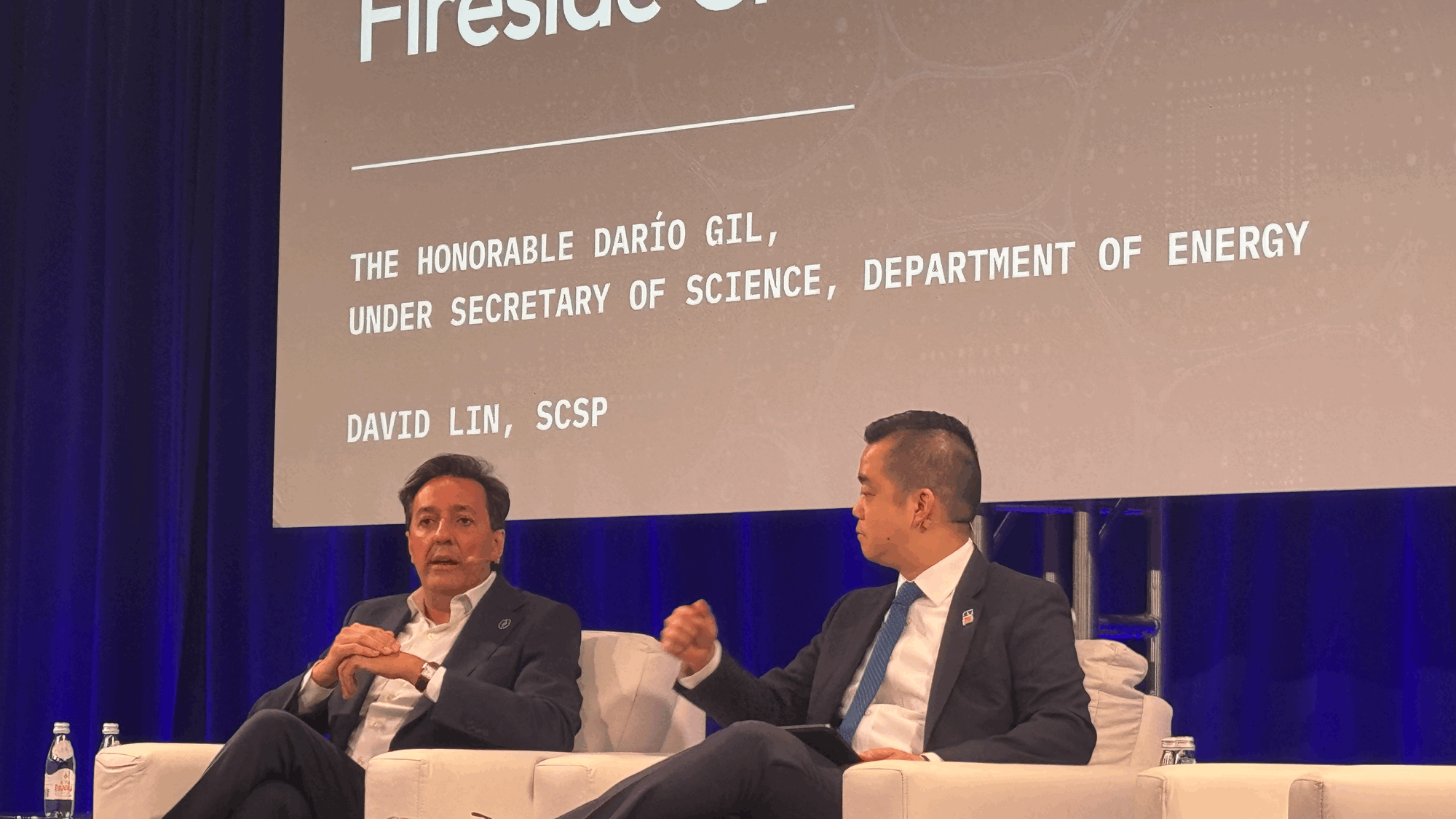
What Darío Gil's remarks at SCSP AI+ Discovery reveal about the Genesis Mission, institutional coordination, and the international competition for AI enabled science
At the Special Competitive Studies Project's AI+ Discovery conference in Washington, D.C., Dr. Darío Gil, Under Secretary for Science at the U.S. Department of Energy and Director of the Genesis Mission, offered one of the clearest descriptions yet of how the United States intends to organize its scientific enterprise around artificial intelligence.
Roughly eight months into the initiative, Gil described an effort that extends well beyond introducing AI tools into individual laboratories. The ambition is to connect the nation's computing capabilities, scientific facilities, researchers, institutions, and funding systems through what he called an "internet of science."
That phrase captures the scale of the vision. The Genesis Mission is not simply an AI program or a collection of research grants. It is an attempt to build shared national infrastructure for AI enabled discovery, mobilize institutions around major scientific challenges, and prepare a workforce capable of operating across science, engineering, computing, and data.
Leadership in AI enabled science will not be decided only by who builds the strongest models or owns the most computing power. It will depend on how quickly a nation can connect infrastructure, talent, institutions, capital, and international partnerships around a shared strategic purpose.
Building an Internet of Science
Gil described the present moment as a convergence of three computing capabilities: high performance computing and simulation, developed by national laboratories over decades; artificial intelligence, particularly systems capable of prediction, reasoning, and planning at scale; and quantum computing, still early stage but positioned to become a third pillar of scientific infrastructure.
The Genesis Mission seeks to connect these capabilities with scientific user facilities, particle accelerators, telescopes, microscopes, advanced manufacturing systems, through agentic systems capable of coordinating increasingly complex scientific and engineering workflows. Rather than applying AI to one isolated step, researchers could eventually use connected systems to support hypothesis generation, modeling, experimentation, and further rounds of inquiry.
Gil drew a direct comparison to the early internet, where shared protocols allowed disparate systems to communicate. In his framing, AI agents would play that same orchestrating role for science: connecting computing systems, facilities, datasets, and research teams. The objective is not simply faster research. It is a structural change in how scientific work is organized.
Three Pillars of the Genesis Mission
Gil organized the initiative around platform, portfolio, and workforce.
The national platform is the infrastructure layer: high performance computers, AI supercomputers, future quantum systems, and specialized models trained across mathematics, physics, biology, chemistry, and engineering.
Gil argued that even the wealthiest American universities have not independently solved the problem of sufficient AI compute for advanced research, and that while national laboratories lead globally in simulation-grade high performance computing, the strongest AI infrastructure remains concentrated in the private sector. The mission is an attempt to give the broader research community structured access to both.
A portfolio of national challenges anchors the initiative in concrete problems. The Department of Energy identified 26 challenges spanning energy, discovery science, and national security, opening 21 for proposals earlier this year with roughly $250 million to $300 million in initial funding. The response, 5,000 proposals from 800 institutions, was a record for the agency, signaling depth of demand across the research community even as different disciplines will inevitably advance at different speeds.
Workforce and education form the third pillar. Gil's premise is that the next generation of scientists will need dual competency, deep disciplinary expertise paired with fluency in AI, computing, and data. He set a goal of a 30 percent increase in American science and engineering PhDs over the next decade, drawing a direct parallel to the National Defense Education Act that followed Sputnik, an investment in talent that helped produce the generation behind subsequent advances in space, defense, and computing. His argument: infrastructure without people who can use it is strategically incomplete.
A Deliberately Broad Mandate
One of Gil's clearest positions was that AI for science should not be confined to a small set of favored fields. Fusion, biology, mathematics, materials science, and cybersecurity may advance at different rates, but every discipline, in his view, should rigorously test where AI improves discovery and experimentation rather than assume in advance it does not apply.
This marks a deliberate departure from prior mission-driven science programs built around a single objective, Apollo's defined destination, the Manhattan Project's singular purpose. The Genesis Mission is structured instead as a platform, its value determined by how broadly it can support work across fields and institutions. That does not imply uniform resourcing; portfolio management will still require prioritization and evidence. But excluding disciplines before they are tested, Gil argued, risks leaving genuine opportunity unexplored.
Collaboration as Infrastructure
Gil identified institutional friction, not technology, as one of the most significant constraints on pace. Traditional collaborative research agreements can take 14 to 18 months to finalize, a timeline that can render collaboration obsolete in a field moving as quickly as AI.
The Genesis consortium, now more than 40 institutional partners across companies, national laboratories, and philanthropies, is designed to compress that timeline structurally. Partnership requirements are built directly into the funding model: teams responding to the initial call for proposals had to collaborate across national laboratories, universities, and industry, on a roughly six-week timeline. Gil acknowledged the pressure this created, but argued it forced new relationships, universities engaging national laboratories, researchers partnering with industry, that might not otherwise have formed. In this framing, collaboration mechanics are not incidental to the mission. They are part of its infrastructure.
Organizing a National Research Enterprise
Gil situated the Genesis Mission within the roughly $1 trillion the United States invests annually in research and development across federal government, private industry, universities, states, and philanthropy, of which the private sector contributes approximately $700 billion.
The mission does not control this ecosystem. Its strategic function is connective tissue: federal agencies identify national challenges and fund shared infrastructure; national laboratories contribute facilities and long-term research capacity; universities supply talent and intellectual diversity; industry brings engineering capability and paths to deployment; philanthropy fills gaps neither government nor commercial funding typically reach. Whether these actors can be mobilized as a coordinated system, rather than remaining fragmented across sectors with limited reason to align, may prove as consequential as any single technical capability the mission produces.
The International Dimension
Coordinating the domestic side of this ecosystem is only half the challenge. The Genesis Mission is also becoming an instrument of international strategy. International partnerships are becoming a structural component of the mission, not an adjunct to it. Gil highlighted a new $1 billion partnership with Japan, the first international partnership under the Genesis Mission, expected to involve shared national challenges, joint investment, and research collaboration, with additional selective partnerships with allied nations to follow.
This matters strategically because AI enabled science cannot be built through domestic policy alone. Infrastructure, data, talent, supply chains, and technical standards are increasingly distributed across borders, and no single country holds every capability required for leadership across all scientific fields. The partners selected to help build emerging scientific platforms will help shape the standards and institutions that grow around them, positioning the Genesis Mission as a potential framework for how the United States organizes strategic scientific cooperation going forward.
Durability Beyond a Single Administration
Gil identified three sources of institutional durability: legislation, evidence, and adoption. He is pursuing bipartisan congressional legislation to give the mission a legal foundation independent of any single administration. He is counting on demonstrated results, in microscopy, particle physics, astronomy, biology, to generate their own momentum, since researchers tend to gravitate toward whatever platform produces better science. And he is counting on community adoption itself: once laboratories, universities, companies, and international partners organize their work around the platform, reversing course becomes institutionally difficult, regardless of changes in political leadership or program branding.
What This Means for Science Diplomacy
Scientific leadership increasingly depends on coordination, not just capability. Advanced models, computing capacity, and world-class laboratories are no longer sufficient in isolation. Competitive advantage now comes from the ability to connect infrastructure, data, and institutions into a functioning system, which means science diplomacy must engage domestic scientific infrastructure and national technology strategy directly, not treat international research relationships as a separate track.
International cooperation is becoming inseparable from technology strategy. The Japan partnership illustrates cooperation structured around shared infrastructure and joint investment rather than isolated research grants. These arrangements shape trusted research networks, data practices, and long-term strategic alignment, blurring the line between scientific cooperation and technology policy.
Speed is now a strategic capability. Gil returned repeatedly to the cost of falling behind on an exponential curve, where a one- or two-year delay can open a gap that later investment cannot close. Governments will increasingly be judged on how quickly they can strike agreements and mobilize institutions, not just on the resources they hold. That raises a real tension for science diplomacy: preserving trust, accountability, and strategic judgment while cutting unnecessary institutional delay.
Access will define the geography of scientific influence. Questions of who gets access to advanced computing and models, which countries connect to shared platforms, and who sets the rules on data governance and openness are not secondary. They will help determine where scientific capability concentrates and which nations gain influence in the AI-enabled research ecosystem now taking shape.
From Technological Capacity to Collective Purpose
The Genesis Mission tests whether the United States can pair its traditionally decentralized science and technology system with real unity around a small number of national goals. That tension is real: the independence of American universities, laboratories, and companies is a genuine strength, but the same fragmentation can slow collective action at the speed the moment requires.
Ultimately, the mission's success will hinge less on any single model or computing system than on whether researchers gain meaningful infrastructure access, whether institutions can collaborate faster, whether results justify sustained investment, and whether durable international partnerships can be built around shared challenges. Gil's remarks made clear that the Genesis Mission is not simply an AI initiative. It is an attempt to reorganize how scientific capability is connected, funded, and shared, and its success will depend as much on institutional coordination and international partnership as on the technology itself.
More analysis on science diplomacy and strategic infrastructure is available at glsd.ai, where ongoing work connects policy, innovation, and international partnerships through a global lens.
New Resource: The Science Diplomacy Playbook
For readers working across diplomacy, technology policy, research strategy, investment, or international partnerships, The Science Diplomacy Playbook: 2026 Edition is now available to order.
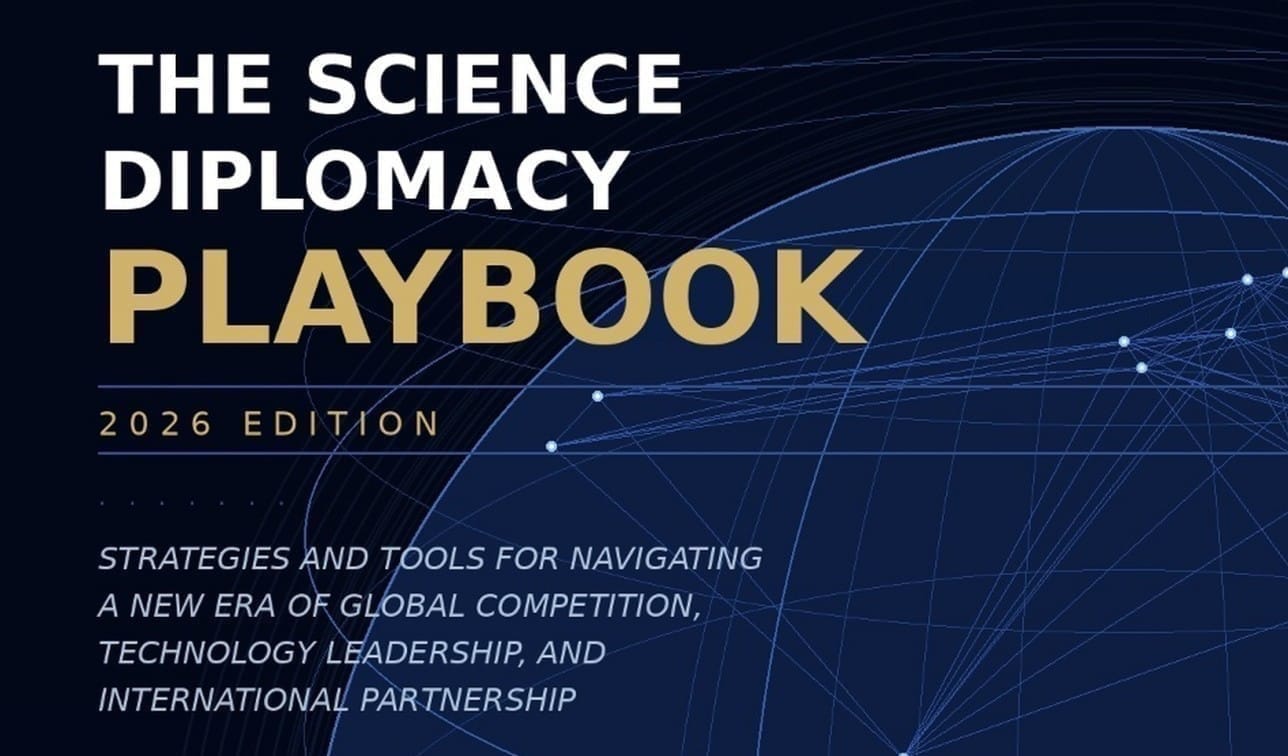
A practical field guide for decision makers navigating the intersection of science, technology, and global affairs.
Available as a paperback and kindle on Amazon, with ebook editions on Apple Books, Fable, and Everand. Library distribution rolling out across North America, the United Kingdom, and Europe through Tolino, Vivlio, Smashwords, Gardners, BorrowBox, and cloudLibrary.