Governing the Final Frontier
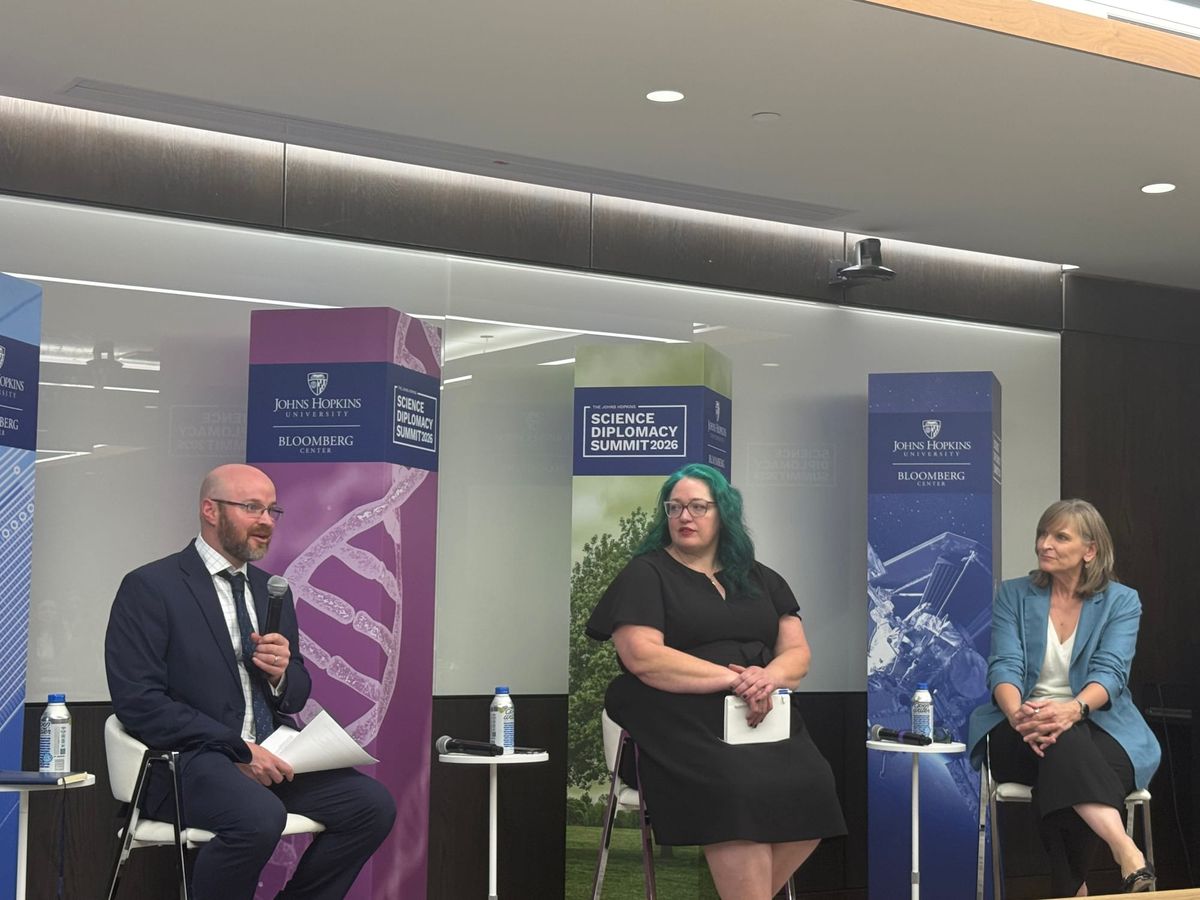
Space's New Architecture of Trust: Inside the Science Diplomacy Summit Panel
At the Science Diplomacy Summit 2026, a panel titled Governing the Final Frontier brought together Frank Justice, Director of the Meridian Space Diplomacy Initiative, Victoria Samson, Chief Director for Space Security and Stability at Secure World Foundation, and Valda Vikmanis, Director in the Office of Space Affairs at the U.S. Department of State, for a timely discussion on how space governance is adapting under pressure from rapid technological, commercial, and geopolitical change.
The discussion made clear that space diplomacy is central to how countries coordinate, compete, and shape norms in a domain that is increasingly critical to economic systems, security architectures, and daily life on Earth, underscoring that space has moved from a peripheral domain to a core arena of strategic alignment and international coordination.
What is being tested is not the absence of governance, but the adequacy of existing frameworks, many of which were designed for a far less complex operating environment. The current legal foundation remains anchored in a set of treaties developed during an earlier era of space activity. The Outer Space Treaty of 1967 continues to provide the core principles of non appropriation, peaceful use, and state responsibility for national activities in space. It is complemented by the Rescue Agreement of 1968, which outlines obligations to assist astronauts, the Liability Convention of 1972, which addresses responsibility for damage caused by space objects, and the Registration Convention of 1975, which establishes transparency through object registration.
These frameworks remain durable and continue to provide essential legal grounding, yet they were not designed for a domain defined by mega constellations, large scale commercial actors, and sustained activity beyond Earth orbit, which is where the pressure now sits between foundational principles and operational reality.
The panel underscored that governance challenges are emerging less from legal gaps and more from scale, speed, and complexity, as tens of thousands of satellites are active or planned, commercial actors operate at a pace that exceeds traditional regulatory cycles, and strategic competition extends into space alongside continued interdependence.
In this environment, governance is no longer a static legal construct but an evolving system of coordination that depends on the ability to align governments, private operators, research institutions, and international partners around shared expectations and practices.
This is where science diplomacy does its most consequential work, as space sits at the intersection of science, policy, security, and industry, requiring not only formal agreements but also practical mechanisms for coordination across actors that do not always share the same incentives, timelines, or strategic priorities.
The Artemis Accords were discussed as an example of this evolving model, as they do not replace existing treaties but instead operationalize principles such as transparency, interoperability, and responsible use of space resources, while also providing an accessible framework for a broader group of countries to participate in shaping norms even without large scale launch capabilities.
This reflects a wider shift toward coalition based governance, where alignment is built through participation and shared practice rather than universal consensus, particularly in areas where formal multilateral agreement is difficult to achieve.
At the same time, orbital activity is exposing the limits of current coordination mechanisms, as space traffic management remains underdeveloped at the global level, with no universally accepted framework governing right of way, collision avoidance obligations, or standardized data sharing across all operators, making the risks increasingly operational rather than theoretical.
In this context, independent and non-governmental resources are becoming essential components of the governance ecosystem, particularly in supporting transparency and shared understanding across a growing and diverse set of actors.
Organizations such as the Secure World Foundation play a critical role in this space by providing widely used analytical tools, reports, and data that support policymakers, operators, and researchers across the global space community. Through resources available at swfound.org, their work includes the Global Counterspace Capabilities Report, which maps the evolving security landscape, as well as legal and policy analyses that clarify how existing treaties apply to emerging activities, alongside publicly accessible materials that enhance situational awareness and operational transparency.
These resources matter because governance in space increasingly depends on shared information environments, where trusted data and independent analysis help bridge the gap between formal regulation and real world operations, enabling both established and emerging space actors to make informed decisions, reduce risk, and engage more effectively in shaping norms.
Taken together, these elements highlight a broader shift in how governance is being constructed, where foundational treaties continue to provide legal grounding while independent analytical institutions and operational frameworks help translate those principles into practice in a more complex and rapidly evolving environment.
Beyond orbit, the discussion also addressed lunar activity and resource use, where the interpretation that extraction can occur without constituting sovereign appropriation is gaining traction in practice, particularly among countries aligned with current U.S. policy, even as important operational questions remain unresolved.
Issues related to proximity, duration of activity, interference, and access are moving from theoretical debate into planning considerations, as multiple actors prepare for sustained presence on the Moon, increasing the importance of coordination mechanisms that can provide clarity before disputes emerge.
Environmental considerations are also becoming more visible, as the cumulative impact of launches, orbital debris, satellite reentry, and broader space activity is still being studied, yet already points to the need for more integrated scientific and policy attention as activity continues to scale.
These dynamics together point to a broader transformation in how space governance is structured, moving from a relatively stable treaty centered system toward a more distributed and layered architecture that combines formal agreements with coalitions, technical standards, operational coordination, and expert driven networks.
This reflects the reality that space is no longer shaped by a small number of state actors but is instead a shared environment where governments, companies, research institutions, and international partnerships interact continuously and shape outcomes together.
The implication is that governance itself is becoming a form of infrastructure, as it enables access, reduces risk, builds trust, and determines who can participate effectively in the system.
Countries and institutions that understand this shift will be better positioned to lead not only in space activity but also in shaping the frameworks that sustain it over time, particularly as the domain becomes more complex, more contested, and more central to life on Earth.
More analysis on science diplomacy and strategic infrastructure is available at glsd.ai, where ongoing work connects policy, innovation, and international partnerships through a global lens.
New Resource: The Science Diplomacy Playbook
For readers working across diplomacy, technology policy, research strategy, investment, or international partnerships, The Science Diplomacy Playbook: 2026 Edition is now available to order.
The guide expands on many of the themes covered in Global Signals, including AI governance, critical minerals diplomacy, bilateral science and technology agreements, minilateral coalitions, research security, and the growing role of science diplomacy in industrial strategy.
It is written as a practical field guide for decision makers navigating the intersection of science, technology, and global affairs.
Available as a paperback and kindle on Amazon, with ebook editions on Apple Books, Fable, and Everand. Library distribution rolling out across North America, the United Kingdom, and Europe through Tolino, Vivlio, Smashwords, Gardners, BorrowBox, and cloudLibrary.
Join Global Signals
A biweekly strategic brief and live briefing series translating science, technology, policy, and global capital flows into strategic insight for decision makers across diplomacy, investment, research, and innovation. Join here.