
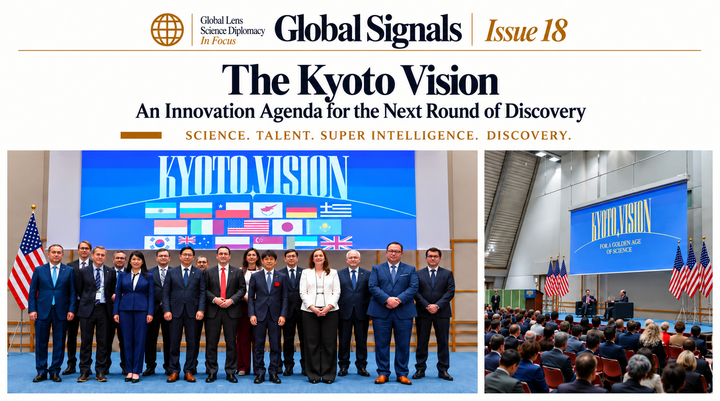
Archive
A collection of 42 issues
AI Force, the UNGA and the Treaty No One Has Ratified
The New Geography of Compute
Three AI Models and the Next Phase of Global AI Governance
Agentic AI, Autonomous Laboratories, and the Next Phase of Science Diplomacy
The Space Race Nobody Is Watching
Building America's Internet of Science
What Darío Gil's remarks at SCSP AI+ Discovery reveal about the Genesis Mission, institutional coordination, and the international competition for AI enabled science At the Special Competitive Studies Project's AI+ Discovery conference in Washington, D.C., Dr. Darío Gil, Under Secretary for Science at the U.
Europe Is Building a Science Diplomacy Operating System
Universities are becoming Europe's front line of science diplomacy Europe is crossing an important threshold in science diplomacy. On 29 May 2026, the Council of the European Union adopted a recommendation outlining the EU's first framework for science diplomacy. Three days later, the Horizon Europe funded
The Execution Layer
The AI Governance Gap: What the UN Secretary General’s Statement Did Not Yet Address
Why governing artificial intelligence requires moving beyond rules and safeguards toward a broader architecture of science, technology, infrastructure, and diplomacy. The UN Secretary General’s remarks at the opening of the first Global Dialogue on Artificial Intelligence Governance rightly underscored foundational imperatives: international cooperation, accountability, inclusion, safety, and the development
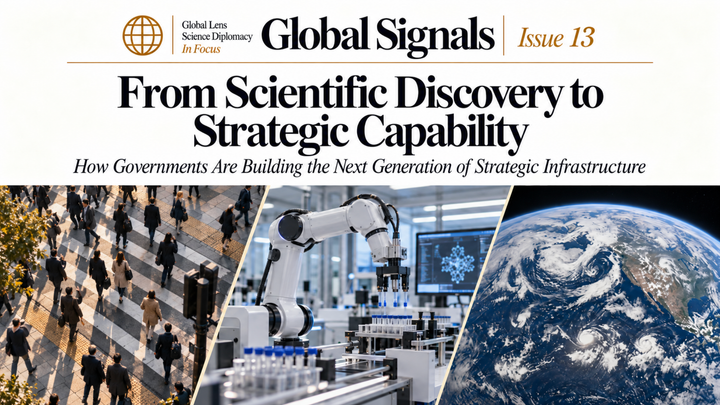
From Scientific Discovery to Strategic Capability
Quantum Moves Into the Center of U.S. National Strategy
The New Infrastructure Economy
America Still Leads in Science, But AI and Strategic Technologies Now Require Institutional Adaptation
Thilo Stadelmann on Pro-Human AI, Trust, and the Technology We Deserve
The dominant narrative in AI governance assumes we are racing toward artificial general intelligence and that the central task of policymakers is to manage that existential risk. Thilo Stadelmann, AI researcher, co-founder of AlpineAI, and Founding Director of the ZHAW Center for Artificial Intelligence , believes that narrative is not
AI, Artemis, and the New Space Infrastructure Economy
The Infrastructure of Power: Energy, Minerals, Orbit, and Qubits
Why Science Diplomacy Needs a Playbook Now
A practical guide for navigating technology governance, critical minerals, global partnerships, and strategic competition. Science diplomacy has moved from a specialized practice to a central operating environment for great power competition, industrial strategy, technology governance, and international partnership. The frameworks being built now on artificial intelligence, critical minerals, technology standards,
Innovation Economies & The Business of Emerging Tech
At the 2026 Emerging Tech Symposium at Johns Hopkins SAIS, the panel on “Innovation Economies & The Business of Emerging Tech” focused less on any single technology and more on the commercial architecture that makes emerging technology possible in the first place. Moderated by Melissa K. Griffith, the discussion featured
Trade, Technology, and the Missing Industrial Middle
At the 2026 Emerging Tech Symposium at Johns Hopkins SAIS, one of the most substantive conversations of the day focused on a question that sits at the center of U.S. economic security strategy: how trade policy, technology leadership, and industrial competitiveness are now converging in ways that can no